 29 September 2026
 As climate challenges intensify, reducing greenhouse gas emissions has become a priority for the entire livestock sector. Among these emissions, methane (CH₄) occupies a central place due to its strong warming power. Indeed, its global warming potential (GWP) is about 84 times higher than that of CO₂ over a 20-year horizon. However, unlike CO₂, which can persist in the atmosphere for more than a century, methane has a relatively short lifespan, estimated at about ten years. This particularity makes it a priority target for climate change mitigation strategies, as a decrease in its emissions can have a measurable effect in the short term. Among the various sources of anthropogenic methane, enteric fermentation of ruminants plays a major role, accounting for 46% of greenhouse gas emissions from livestock farming (IPCC, 2023).
However, ruminants play an essential role in our food system. Thanks to their unique digestive system, they are able to use resources that are not edible by humans, such as fodder and grassland, to produce high-quality milk and meat.
The challenge is therefore not to question ruminant farming, but to find solutions to reduce their environmental impact while maintaining their performance.
Ruminants have a digestive compartment called the rumen, a real natural fermentation tank.
In the rumen, a complex ecosystem of billions of microorganisms breaks down plant carbohydrates, including fibre, into volatile fatty acids (VFAs), which are the animal’s main source of energy for growth, milk production and reproduction. During these fermentations, hydrogen is produced and then used by specialised micro-organisms, methanogenic archaea, to synthesize methane (CH₄). Once formed, this gas is mainly removed by belching (about 95% of emissions), while the remaining fraction is released via the faeces.
This fermentation is essential for the functioning of the rumen, but it is accompanied by a loss of feed energy for the animal. According to the FAO, up to 12% of the raw energy ingested can be lost in the form of methane.
Reducing this production therefore has a double interest:
An objective shared by the entire sector
Methane mitigation is now at the heart of agricultural decarbonisation strategies.
The livestock sectors, cooperatives, processors and animal nutrition stakeholders are committed to a common approach aimed at:
At COP26, signatories to the Global Methane Pledge set a goal to reduce global methane emissions by 30% by 2030 compared to 2020.
Among the various avenues for reduction studied by research, animal nutrition appears to be one of the most accessible and quickly mobilized levers.
Scientific work carried out in recent years shows that it is possible to act on rumen fermentation mechanisms thanks to specific combinations of nutritional ingredients. Among the levers identified are:
The effectiveness of a methane reduction strategy relies on its ability to redirect hydrogen flows within the rumen to other, more efficient fermentation pathways, including propionate production, while preserving the activity of fibrolytic bacteria.
Reduce methane without compromising performance
The real challenge is not just methane reduction.
To be sustainable and adopted by farmers, a solution must also preserve:
At MG2MIX, we have developed METHA’MIX, a range of nutritional solutions designed to support farms in their environmental transition.
Our approach is based on a simple conviction: Reducing methane should never come at the expense of performance.
METHA’MIX combines different nutritional levers recognized for their interest in controlling rumen fermentation.
The range is available in three levels of expertise:
Combination of a specific core of essential oils and selected plant extracts to provide an effective first response at low doses of incorporation.
METHA’MIX INTENSE reduces methane emissions by 10% while improving milk performance by 0.9L/cow/day.
Combination of core, plant extract and tannins to mobilize several complementary methane-reducing mechanisms and support performance.
METHA’MIX CORE reduces methane emissions by 10% while improving milk performance by 1.2L/cow/day.
Combination of plant extracts, tannins and sainfoin to meet the needs of farms looking for an advanced nutritional strategy.
METHA’MIX EXPERT reduces methane emissions by up to 13.2% while improving milk performance by 1.6L/cow/d.
Innovation validated by science and the field
METHA’MIX has benefited from a scientific collaboration with INRAE, UMR HERBIVORE, as part of in vitro evaluations aimed at studying its impact on the mechanisms of methane production.
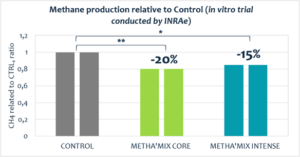
Figure 1 Effect of METHA’MIX CORE and INTENSE on methane production. The results are expressed relative to the control, set at 1. Significant differences compared to the control: *p<0.05; **p<0.01.
This research phase was then completed by a dozen in vivo validation trials carried out on MG2MIX research farms in order to confirm the results under conditions close to the reality of farms.
This approach makes it possible to combine:
Reducing methane emissions is one of the main levers for lowering the environmental footprint of ruminant farms.
Thanks to advances in research and animal nutrition, it is now possible to act effectively on this issue while preserving the technical and economic performance of farms.
Reducing methane emissions is no longer just an environmental issue. It is now a lever for competitiveness, for the enhancement of farms and for adapting to societal expectations. With METHA’MIX, MG2MIX intends to provide farmers with concrete, scientifically validated solutions that can be directly applied in the field.
Our experts are available to support you, don’t hesitate to contact them here
 Menu
Menu